
LEO IS FOLLOWING FRANCIS’ ABUSE COVER-UP PLAYBOOK
November 22, 2025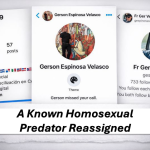
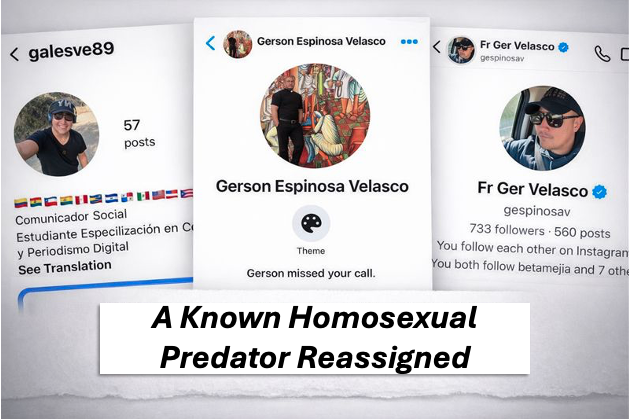
Why Was Known Homosexual Predator Fr. Gerson Espinosa Reassigned to St. Rose of Lima Instead of Removed?
February 3, 2026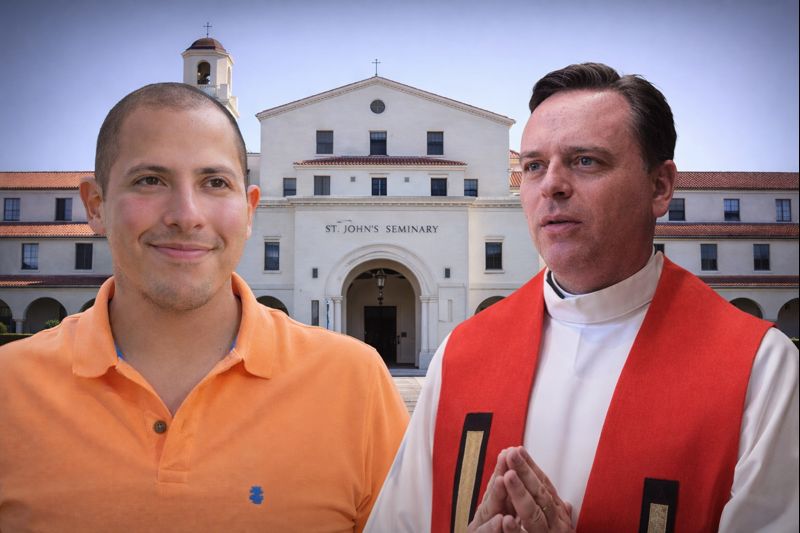
Same Seminary. Same Characters. Same Warnings. Same Silence.
When Clean the Church exposed St. John’s Seminary as a nexus of corruption, sexual misconduct, and institutional protection, the takeaway was never meant to be historical. It was diagnostic.
What happens when formation is broken does not stay contained. It spreads.
A newly filed clergy misconduct complaint in San José, California—this time involving Fr. Gerson Velasco Ospina (also known publicly as Gerson Espinosa Velasco)—raises troubling questions about whether the Church has learned anything at all.
According to a 41-page formal complaint submitted in April 2025, an adult male parishioner alleges grooming, sexual exploitation, rape, and abuse of spiritual authority by Fr. Velasco. The complaint is supported by extensive contemporaneous documentation, screenshots, timelines, and sworn statements.
This is not an isolated accusation. It is another data point in a system we already understand.
St. John’s Seminary Is not a “Bad Chapter.” It is a Homosexual Culture.
Clean the Church has documented how St. John’s Seminary functioned for years as a closed ecosystem where:
- sexual misconduct was tolerated when kept quiet,
- complaints were minimized or buried,
- whistleblowers were isolated,
- and formation prioritized loyalty over integrity.
The result was predictable: men were ordained into a system that normalized boundary violations and rewarded discretion over accountability.
This context matters. Priests do not emerge in isolation. They are formed, vetted, advanced, and protectedby institutions that shape behavior long before any parish assignment begins.
When the Church insists each new case is an aberration, it ignores the common denominator: formation without consequences.
Marco Durazo and the Price of Truth
Readers of Clean the Church already know Marco Durazo—not as a headline, but as a cautionary example.
Durazo’s experience revealed the institutional reflex that continues to define clerical crisis management: deny, delay, discredit, and deflect.
Those who raise concerns are not met with reform. They are met with process. And when process fails, they are met with silence.
That history explains why survivors come forward armed with documentation—and why institutions often respond by scrutinizing the messenger instead of the message.
Importantly, this case cannot be viewed in isolation from the institutional history of St. John’s Seminary. There are allegations that Gerson Espinosa engaged in a romantic and sexual relationship with Marco Durazo while Espinosa was a seminarian and Durazo was serving as Director of St. John’s Seminary. If true, such a relationship would represent a profound breach of power, ethics, and formation standards—placing a seminarian in a sexual relationship with the very official responsible for his supervision, evaluation, and advancement. These allegations, long whispered and never credibly addressed, further underscore the culture of boundary erosion and protected misconduct that Clean the Church has documented at St. John’s. They also raise a critical question: whether behaviors later alleged in parish life were first normalized during seminary formation under compromised leadership.
What the San José Complaint Alleges
According to the evidence file, contact between the male complainant and Fr. Velasco began in December 2023 via Facebook Messenger and escalated over time into emotionally intimate and sexualized communication.
The most consequential detail appears early:
Before any in-person meeting, the complainant states he explicitly disclosed to Fr. Velasco that he had been groomed and abused by a priest in Colombia beginning at age 13. He sought spiritual guidance.
That disclosure should have triggered strict pastoral boundaries.
The complaint alleges it did not.
Instead, Fr. Velasco is accused of engaging in conduct consistent with grooming dynamics, including:
- repeated use of infantilizing terms such as “niño” and “muchacho,”
- emotionally charged and sexually suggestive messaging,
- and arranging a hotel meeting that crossed clear ethical and pastoral lines .
These behaviors are not ambiguous within safeguarding frameworks. Infantilization, sexualized familiarity, and escalation after trauma disclosure are well-documented grooming markers—especially when initiated by someone holding spiritual authority.
The Conduct That Followed the Complaint Is Equally Alarming
The allegations do not end with the encounter.
According to the complaint, after the Diocese was formally notified, Fr. Velasco allegedly:
- continued to monitor the complainant’s social media activity,
- attempted contact across multiple platforms despite disengagement,
- and used a secondary, non-clerical social media account to maintain indirect access .
This matters.
Because institutional reform is not measured by words. It is measured by behavior under scrutiny.
Gerson Espinosa continues to be a “priest in good standing” today.

Allegations Are Not Verdicts. Silence Is a Choice.
To be precise:
Fr. Gerson Velasco Ospina has not been convicted of a crime at the time of publication. These are allegations, currently under ecclesiastical review and potentially civil consideration.
But allegations supported by detailed documentation demand investigation—not obscurity.
The Church already knows what happens when seminaries like St. John’s are protected at all costs. Marco Durazo’s experience showed us the human cost of that strategy.
The question facing the Church now is not complicated:
TIMELINE SIDEBAR
Key Events Relevant to This Case
St. John’s Seminary (Historical Context)
- Years of documented allegations involving sexual misconduct, protected clergy, and retaliatory responses to whistleblowers (as reported by Clean the Church).
December 29, 2023
- Initial contact between complainant and Fr. Gerson Velasco via Facebook Messenger .
Early 2024 (Phone Conversation)
- Complainant discloses prior grooming and abuse by a priest in Colombia beginning at age 13; seeks spiritual guidance.
February–March 2024
- Escalation into emotionally intimate and sexually suggestive communication; use of infantilizing language alleged .
March 29, 2024
- Alleged in-person hotel encounter in San José following explicit coordination.
April 5, 2025
- Formal clergy misconduct complaint submitted to the Diocese.
April 2025 (Post-Complaint)
- Alleged continued monitoring and indirect contact through multiple social media platforms and a secondary account .

1 Comment
[…] According to reporting published by Clean the Church, a formal complaint details allegations that Espinosa engaged in grooming behavior, abuse of spiritual authority, and sexual assault described by the complainant as rape. The documentation includes timelines, communications, and corroborating material that were formally submitted to Church authorities.(Source: A New Complaint of Rape Against Fr. Gerson Espinosa by a Male Parishioner Raises Urgent Que…) […]